The 25-Year Anniversary of the Device That Put a Thousand Songs in Your Pocket
Two decades and five years after its introduction, the original iPod remains a landmark in consumer electronics for its ability to consolidate a user's entire music collection into a pocket-sized form factor.
By Thomas Reynolds ·
On this day in 2001, Apple CEO Steve Jobs introduced a device that would redefine how the world consumed music, unveiling the original iPod in a presentation that began with the promise of a breakthrough gadget that was not a Mac. The announcement marked a pivotal moment in the history of portable electronics, establishing a product that would become the preferred companion for gadget enthusiasts long before smartphones matured enough to render dedicated music players obsolete. The core proposition was simple yet revolutionary: for 399 dollars, consumers could carry their entire music library in their pocket.
The launch occurred at a critical juncture for the Cupertino-based company, which had just emerged from the dot-com bubble era. By October 2001, Apple had successfully navigated the transition into the Mac OS X era, with its iMacs and iBooks establishing a foothold in the consumer market. Jobs envisioned a future where the Mac served as the central hub for a user's digital lifestyle, connecting cameras, camcorders, DVD players, and portable audio devices. He identified music as a massive, untapped target market lacking a clear industry leader, a gap Apple intended to fill.
At the time of the unveiling, the portable audio landscape was fragmented. Competitors such as Sony, Creative, and Sonic Blue offered various solutions, but Jobs argued that none had yet discovered the correct formula for digital music. The market was divided among CD players, MP3 CD players, flash-based devices, and hard disk-based jukeboxes. Apple selected the hard disk-based approach as its entry point, leveraging the technology to offer a capacity that competitors could not match at the time.
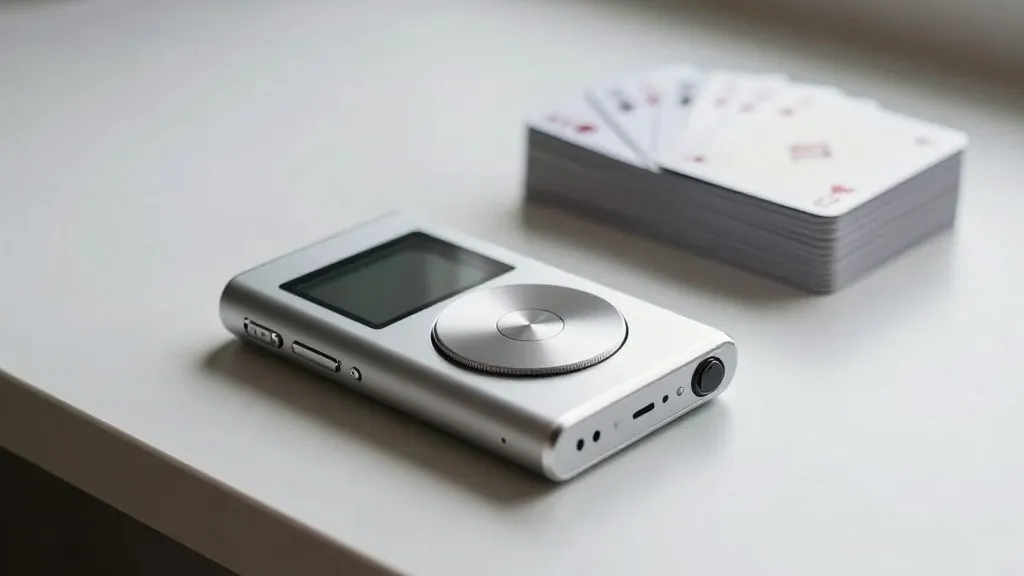
The device’s specifications were designed to emphasize convenience and capacity. The first iPod featured 5GB of storage, which translated to 1,000 typical pop songs encoded as 160Kbps MP3 files. Jobs described this as encompassing the entire music library for most users. The physical form factor was equally significant, measuring 2.4 by 4 by 0.78 inches and weighing just 6.5 ounces. This made it lighter than many contemporary cell phones and roughly the size of a standard deck of cards, a design achievement made possible by Toshiba’s ultra-compact 1.8-inch hard drive, which was only 0.2 inches thick.
Performance was a key differentiator, particularly in data transfer speeds. The device utilized a FireWire 400 connection, which Jobs claimed was the first and only feature on a music player at the time. This connection allowed for the transfer of an entire CD’s worth of data in as little as five to ten seconds, a stark contrast to the roughly five minutes required for USB transfers of the same era. To fill the entire 5GB capacity, users could expect the process to take approximately ten minutes, compared to five hours for a USB-based equivalent.
Power management was another area of focus. The device included a rechargeable lithium-polymer battery capable of providing ten hours of continuous playback. Apple stated that an empty battery could be recharged to 80 percent capacity within one hour. The design prioritized durability and minimalism, with Jobs highlighting the clean aesthetic of the back and sides. The interface featured a single-hand-friendly control system, including a scroll wheel with a piezoelectric clicker that provided tactile feedback, allowing users to quickly navigate playlists, artists, or individual tracks.
The software ecosystem was launched simultaneously with the hardware. iTunes 2 debuted on the same day, introducing features such as MP3 CD burning and synchronization support. The Auto-Sync function ensured that any library curated on a Mac would remain perfectly aligned with the portable device during charging or data transfer. Additionally, the iPod could function as a FireWire hard disk drive, adding further utility to the hardware.
The device’s cultural impact was immediate. During the initial demonstration on stage, the first track played was “Building a Mystery” by Sarah MacLachlan. The product line would endure for nearly two decades, coexisting with the iPhone, which launched in early 2007, for over a decade. Although the iPhone eventually absorbed many of the iPod’s functions, the iPod line continued until the release of the 7th-generation iPod Touch in May 2019. The product line was left unmaintained for a period before being officially discontinued in May 2022, marking the end of an era that began 25 years ago.
The legacy of the original iPod is cemented not just in its sales figures, but in its influence on the design and functionality of subsequent personal devices. It established the template for how users interact with portable media, prioritizing ease of use, compact design, and seamless integration with personal computers. As the 25th anniversary of its debut arrives, the device remains a testament to the power of combining innovative hardware with intuitive software to create a product that changes daily habits.
Source: Tom's Hardware